


Villa Elevator Essentials: A Practical Guide from Selection to Installation
Home elevators are shifting from a luxury feature to a practical necessity in many villas. Yet with three mainstream drive types—traction, screw-driven, and hydraulic—plus a maze of technical parameters like hoistway dimensions, pit depth, and headroom, many homeowners struggle to know where to begin. This article breaks down the core knowledge in plain language, giving you a clear framework for making the right decision.
1. Three Drive Types: Which One Fits Your Home?
Traction elevators are the most mature and widely adopted technology, using friction between steel ropes and a traction sheave to move the cabin. They offer smooth operation, faster speeds (typically 0.3–0.4 m/s), low energy consumption, and the most established maintenance ecosystem-5. The trade-off is demanding civil requirements: a dedicated hoistway, a pit depth of at least 350mm, and headroom generally no less than 2,600mm-5. Best suited for new-build villas where the hoistway is planned from the design stage.
Screw-driven elevators have gained significant traction in recent years. A motor rotates a nut along a vertical screw to move the platform—no ropes, no oil, no counterweight. The standout advantage is spatial adaptability: minimal pit depth (as little as 50–100mm), no machine room required, and a self-locking mechanism that structurally eliminates the possibility of free fall-5. The trade-off is speed—typically only 0.15–0.25 m/s—with a maximum travel height of around 15 meters-5. Ideal for retrofits in existing villas, duplexes, and unconventional spaces such as stairwell voids.
Hydraulic elevators once held a share of the home market, using oil pressure to lift the cabin. They offer strong load capacity and smooth motion. However, oil leakage risk, temperature sensitivity, and higher energy and maintenance costs have gradually pushed them to the margins of the high-end villa market-2-5. Unless there is a specific heavy-load requirement, they are generally not the first choice.
In short: new builds with sufficient space → traction; retrofits with limited space → screw-driven; hydraulic → largely ruled out unless there's a compelling reason.
2. Three Commonly Overlooked Factors in Selection
First, safety certification comes before everything else. In most regions, villa elevators are not subject to mandatory special equipment supervision—which means the less external enforcement exists, the more the homeowner must take responsibility for safety-11. Prioritize products with authoritative third-party safety certifications and focus on system-level redundancy rather than individual components: door lock interlocks, emergency leveling on power failure, and entrapment self-rescue procedures-11. The core reference standard for home elevators in China is GB/T 21739 Safety Rules for the Construction and Installation of Home Lifts, with a revised version released in 2025 replacing the 2008 edition-.
Second, the "three hoistway essentials" determine feasibility. Net width, net depth, and headroom directly determine which elevator type and cabin size are possible-11. Many homeowners only consider an elevator late in the renovation process, only to discover insufficient headroom or an unexcavatable pit, forcing them to abandon or drastically scale back their plans. The smart approach is to involve an elevator supplier during the villa design stage, not after civil works are complete.
Third, "cabin-to-hoistway ratio" matters more than spec sheets. This refers to how much usable cabin space you get within a given hoistway footprint. Narrow door operators, slim counterweights, and compact guide rail layouts all improve this ratio-11. An elevator with impressive specs but a cramped cabin may deliver a far worse daily experience than one with modest specs but excellent space utilization. A clear door opening of at least 700mm is the practical threshold; wider is always better if conditions allow-11.
3. Installation & Maintenance: 30% Product, 70% Execution
There's a saying in the elevator industry: 30% product, 70% installation. Guide rail verticality must be controlled to millimeter-level tolerances. Hoistway waterproofing, dedicated power supply provisions, and landing door interlocking are all links where a single oversight can lead to noise, vibration, or safety hazards down the road-20.
On maintenance, home elevators require less frequent servicing than commercial ones—typically a routine inspection every 3–6 months, with a comprehensive annual check-. Annual maintenance costs in China generally range from ¥3,000 to ¥6,000, depending on brand, type, and usage frequency-. When purchasing, clarify the after-sales response time, spare parts availability period, and whether the maintenance contract is included in the total price.
The Bottom Line
The decision logic for a villa elevator is actually straightforward: safety certification first, spatial conditions second, aesthetics and budget last. Don't get swept up in sales pitches. Filter every proposal through three questions—Can it be installed? Will it be installed well? Will I feel safe using it for years to come?—and you'll avoid the major pitfalls.
FAQ
Does a villa elevator require mandatory annual inspection like a public elevator?
In most regions, a home elevator used solely by a single family and not for public operation is not subject to mandatory special equipment annual inspection. That does not mean maintenance-free. Schedule a professional inspection every 3–6 months and a thorough annual service. Confirm compliance with GB/T 21739, Safety Rules for the Construction and Installation of Home Lifts, and keep maintenance records. If local regulations differ, follow the local market regulator’s requirements.
What should I do if I’m trapped due to a power outage or fault?
Stay calm. Do not force the doors open or try to climb out. If the elevator has emergency leveling on power failure, it will use backup power to move to the nearest floor and open the doors. If not, use the emergency call, intercom, or phone to contact family or after-sales service. Screw-driven elevators have a self-locking structure and will not free-fall. Waiting for professional rescue is the safest option.
Are home elevators noisy? How can noise be reduced?
Noise depends mainly on the drive type, installation quality, and hoistway location. Traction elevators are generally smoother and quieter; screw-driven models may have more mechanical noise, though quality products can keep cabin noise around 50–60 dB. Key measures: avoid sharing a wall between the hoistway and bedrooms; add vibration isolation pads under the machine; lubricate guide rails regularly; choose low-noise door operators; and ensure precise vertical alignment and fastening. In many cases, installation quality matters more than brand specs.

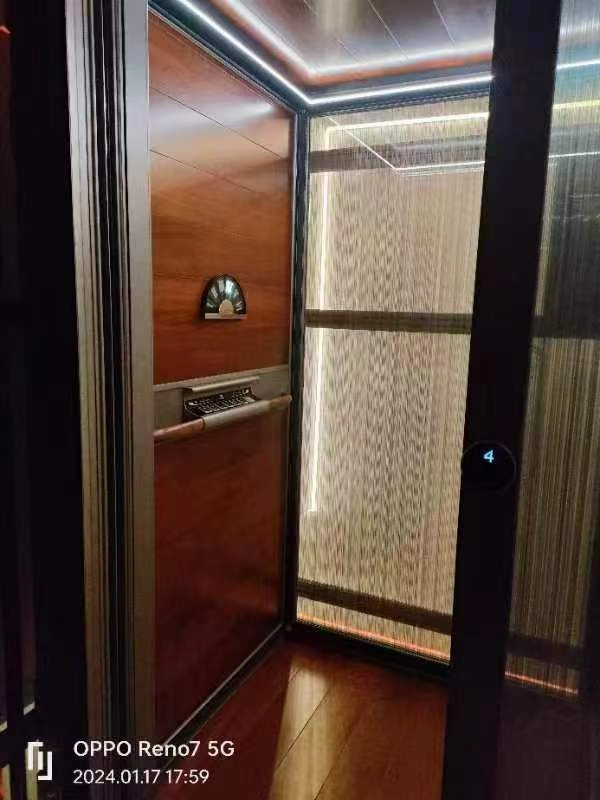
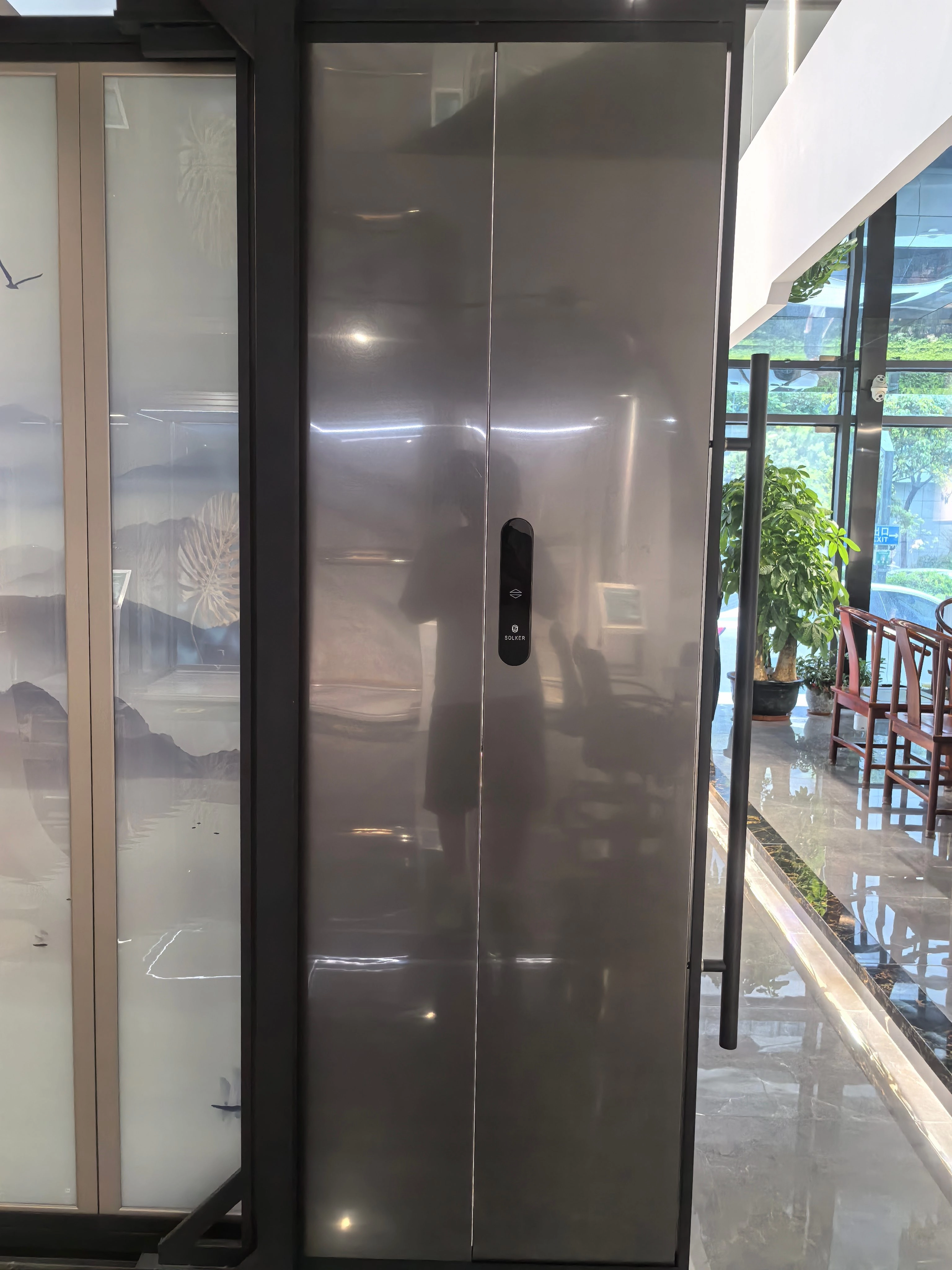

Customize
Is customization available for both indoor and outdoor elevators?
Yes. All custom options apply to indoor and weatherproof outdoor models.
How does the customization process work?
Our design team will guide you through the steps: style selection, material choice, and 3D visualization before confirmation.
How long does a custom order take to deliver?
On average, production takes 30–45 days after confirmation, depending on your configuration.
Can the elevator design be matched to my home's architecture?
Absolutely. Our designers tailor each cabin to complement your interior layout and style.
Can I customize the elevator to match my home style?
Absolutely. We offer multiple cabin styles, materials, and finishes to suit modern, classic, or minimalist interiors.
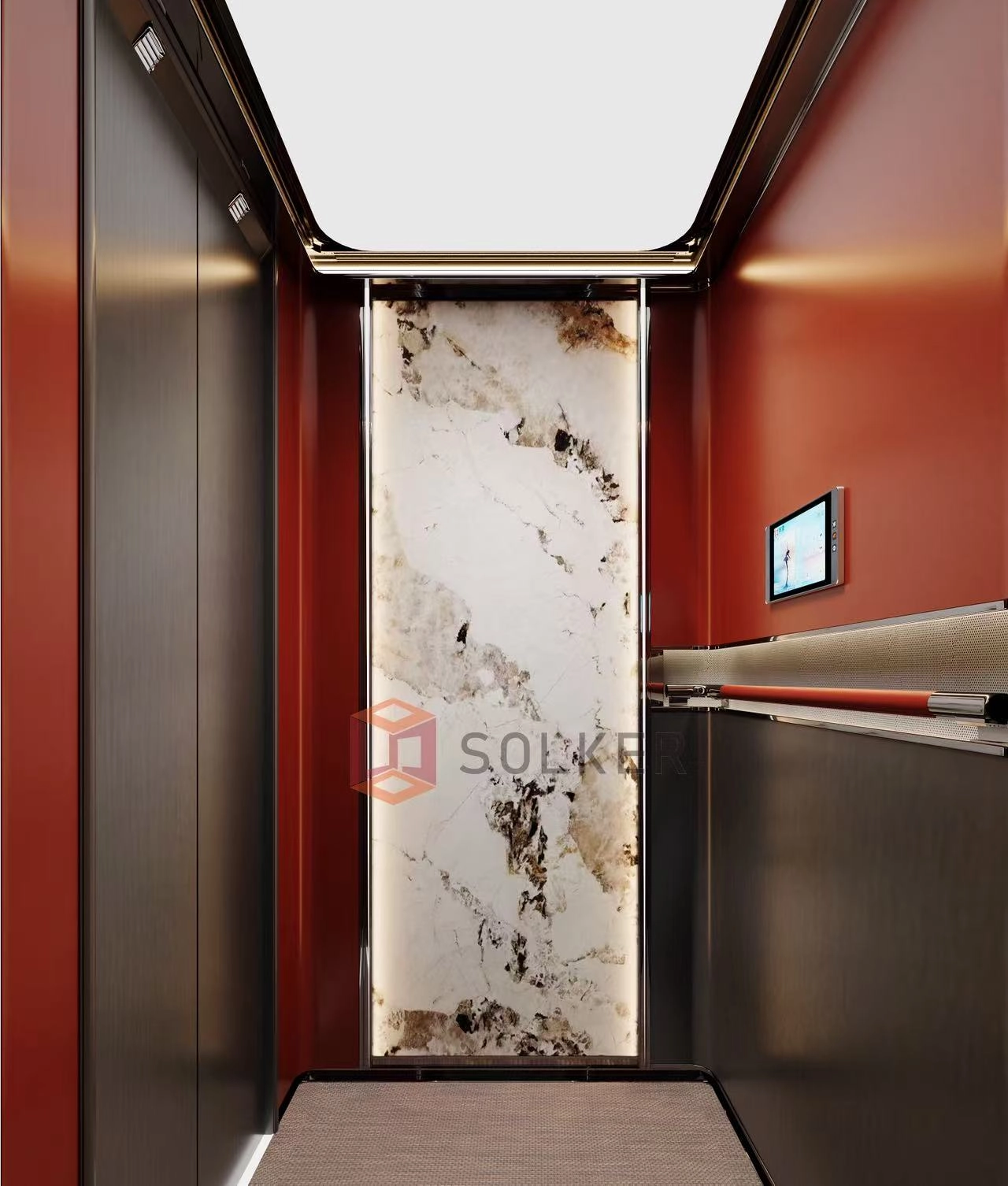
The SOLKER Model-Q3 villa elevator features a Bordeaux Red cabin interior, harmonizing the natural texture of Pandora stone with linen-textured elegant grey stainless steel, accented by refined metal trims. SOLKER's exclusive fully curved seamless integrated forming technology delivers a fluid, joint-free cabin that enhances both safety and aesthetics. Equipped with a built-in HD smart display, every ride becomes a premium experience where technology and artistry converge.

The Model A is a home villa elevator in the Italian minimalist style. It features the most advanced elevator technology and has comprehensive safety protection measures. It is the most reliable guarantee for your passage in villa homes.

The Model-Mini is a home villa elevator in the Italian minimalist style. It features the most advanced elevator technology and has comprehensive safety protection measures. It is the most reliable guarantee for your passage in villa homes
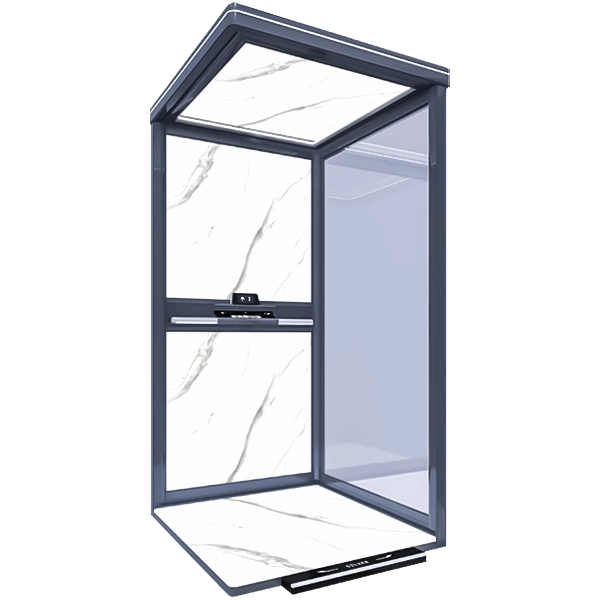
The Model-S is a home villa elevator in the Italian minimalist style. It features the most advanced elevator technology and has comprehensive safety protection measures. It is the most reliable guarantee for your passage in villa homes.
Looking for custom villa lifts manufacturing solutions?
We provide full-service OEM & ODM solutions—from concept to delivery.
Design, prototyping, production, and shipping—all in one place.
Fill out the form below for a free quote or consultation.
👉 Contact us today to start an exclusive customized partnership.
📦 Get product catalogs and wholesale prices.
🔧 Submit your design requirements for 1-to-1 exclusive matchmaking.
🌍 Become our global distribution partner.
Rest assured that your privacy is important to us, and all information provided will be handled with the utmost confidentiality.
Let's get in touch
Email: lin@solkerelevator.com
Tel: +86 133 1668 7566
Address: Floor 1, Building D, Nanxin Industry International, Nancheng District, Dongguan, China.
 Taiwan, China
 No. 21, Lane 38, 206 Yingtai Road, Yingge District, New Taipei City
 +886 0975-299-830
 United Arab Emirates
Capital Mall, Abu Dhabi, United Arab Emirates, 3rd floor, Luxera elevator +971 52 541 4685 Ceo@maharacare.com
 Melbourne, Australia
 19/12 Natalia Av, Oakleigh South, VIC 3167
+61 1300 771 86 sales@goldenhomelifts.com.au
Sydney, Australia
U28/323 Chisholm Road, Auburn, NSW 2144
+61 1300 771 86 sales@goldenhomelifts.com.au
SOLKER
SOLKER